Dominican Republic Real Estate Investment: Why It Outperforms Other Caribbean Options

For North American investors evaluating the Caribbean, the question is rarely whether to invest in the region, but where. Increasingly, the answer is the Dominican Republic, and Punta Cana in particular, for reasons that hold up under scrutiny: full ownership rights for foreign buyers, a 15-year tax exemption on qualifying properties, dollar-denominated assets, and rental income supported by one of the Caribbean's most resilient tourism economies. This guide sets out the investment case in detail, compares Dominican Republic real estate against the region's other established markets, and addresses the concerns that matter most when purchasing from abroad.
It is written from the perspective of a developer rather than a listing portal. NOVAL Properties has operated in the Dominican market for 22 years and delivered more than 3,000 units. That experience informs both the figures presented here and the candor with which we treat the market's risks, which are real and worth understanding before you commit capital.
Why the Dominican Republic outperforms other Caribbean markets
The Caribbean offers no shortage of destinations, but they are not equivalent as investments. Measured on the factors that determine an international buyer's return, the Dominican Republic consistently compares favorably with the alternatives most North Americans consider:
Against Mexico (Cancún, Tulum): Mexico restricts foreign ownership within its coastal zone, requiring a bank trust (fideicomiso) with ongoing fees. The Dominican Republic grants foreigners direct freehold ownership in their own name, with no such structure required.
Against the Bahamas and Cayman: entry prices and carrying costs are materially lower in the Dominican Republic for a comparable beachfront product, while both markets share the advantage of USD-denominated or USD-pegged pricing.
Against Costa Rica: the Dominican Republic offers stronger international airlift, higher tourism volume, and the CONFOTUR tax exemption, which has no direct equivalent in the Costa Rican market.
The common thread is a combination that is difficult to assemble elsewhere: unrestricted freehold ownership, a significant tax holiday, lower entry pricing, and a dollar-denominated market.
The investment case: tourism, growth, and a dollar economy
The fundamentals behind these returns are not speculative. Over the past decade, the Dominican Republic has recorded one of Latin America's highest and most stable GDP growth rates, averaging above 5% annually, supported by tourism, foreign direct investment, and construction. The World Bank consistently ranks it among the region's fastest-growing economies.
Tourism is the engine. The country receives more than 10 million visitors a year, and Punta Cana International Airport is among the busiest in the Caribbean, sustaining the year-round occupancy that vacation-rental returns depend on. The continued presence of operators such as Meliá, Hilton, Marriott, and Four Seasons is a useful signal of where institutional capital sees durable value. For the foreign investor, the final advantage is monetary: assets and rental income are denominated in U.S. dollars, insulating the investment from local-currency volatility.
Where to invest: Punta Cana real estate and beyond
The market is not uniform, and the right zone depends on the investor's objective. These are the areas that concentrate the most credible investment activity:
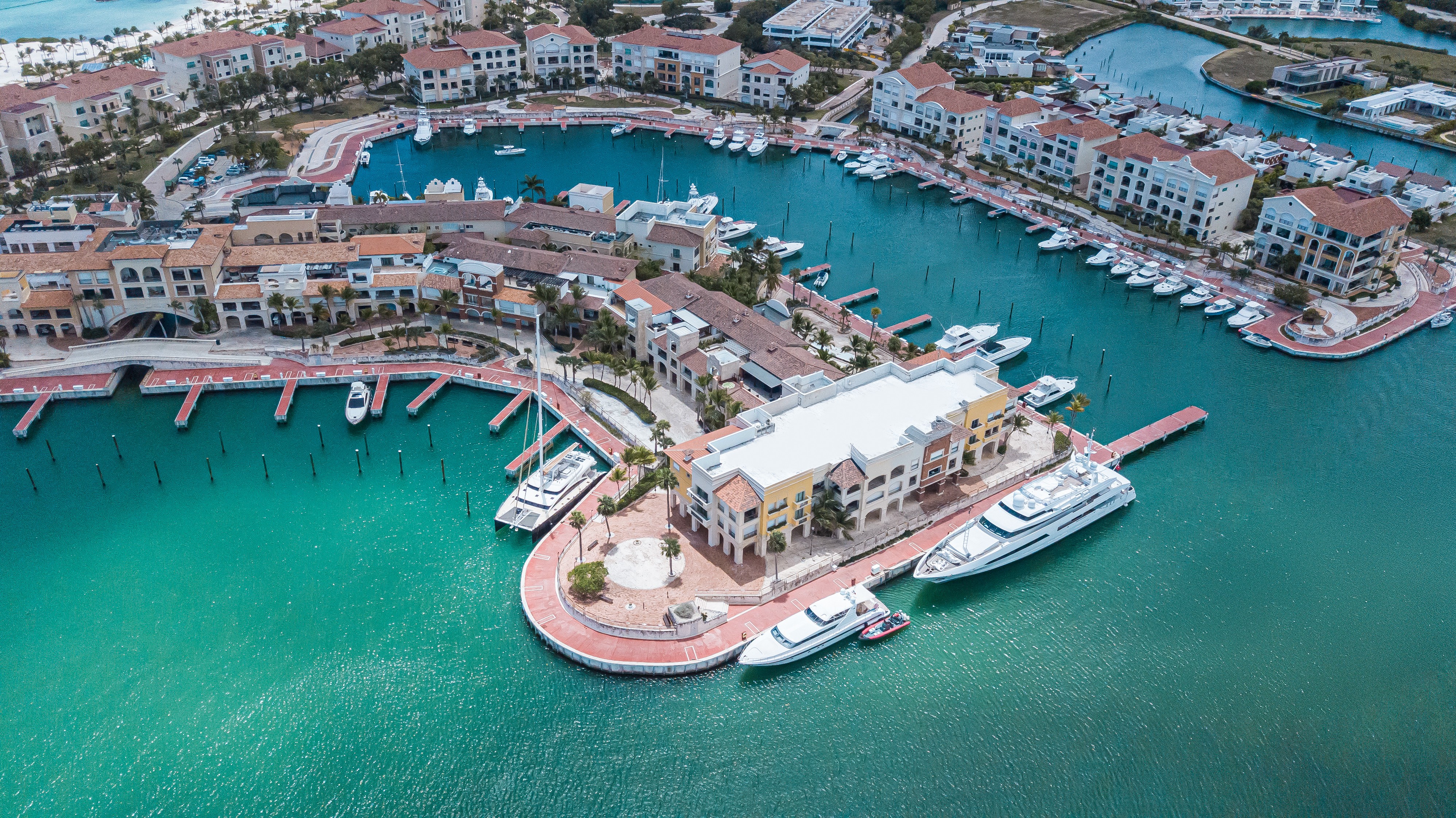
Cap Cana. The premier luxury enclave, gated and master-planned, with marina, golf, and branded residences. Best suited to capital preservation and high-end appreciation.
Bávaro and Los Corales. The core of vacation-rental demand, with the strongest short-term occupancy and the broadest tenant pool. The natural choice for yield-focused buyers.
Punta Cana Village. Driven by local professionals and long-term tenants, offering steadier, lower-management income and low vacancy.
Las Terrenas and Santo Domingo. Beyond Punta Cana, Las Terrenas offers a boutique coastal market with a strong European and Latin American buyer base, while Santo Domingo provides urban, less seasonal diversification.
NOVAL develops across this corridor (Punta Cana and Cana Bay, Las Terrenas, Santo Domingo, and Juan Dolio) because these are the markets where demand is demonstrable and appreciation has a basis beyond marketing.
What you can earn: rental yields and ROI
Returns come from two sources: rental income and appreciation. On the income side, prime, well-managed properties commonly produce gross vacation-rental yields of 7% to 10%, which translates to a realistic net of roughly 5% to 8% once management and operating costs are accounted for, and higher in premium hotel-managed products. Long-term rentals yield less but demand less management.
Appreciation adds a second layer. Resale values in established zones have historically risen 3% to 8% per year, while purchasing pre-construction typically captures 15% to 20% appreciation by the time the development is delivered.
The tax advantage: CONFOTUR and property tax
The Dominican Republic's most distinctive financial feature is its tourism-investment law, known as CONFOTUR. On a qualifying development, it exempts the buyer from the 3% property transfer tax at closing and from the annual property tax (IPI) for 15 years, as well as from income tax on rental earnings during that period. The effect on net return is material rather than cosmetic.
Outside CONFOTUR, the standard property tax (IPI) is a modest 1% applied only to the value of an individual's holdings above an exemption threshold of roughly US$166,000. For many foreign buyers, the combination of a low baseline rate and the CONFOTUR exemption results in carrying costs well below those of comparable U.S. or European markets.
How foreigners buy property in the Dominican Republic
The process is well established and, handled correctly, secure. Foreign buyers enjoy the same rights as citizens, and the title system is government-backed. The essential steps are as follows:
Engage independent professionals. Retain your own attorney, separate from the seller, and a reputable agent. In the Dominican Republic an attorney is legally required to execute the transaction.
Confirm a clean, registered title. The country uses a Torrens-style registry. Your attorney verifies that the property is properly titled, not sold as informal "possession rights."
Sign the Promise of Sale. A binding ‘Promesa de Venta’ sets out price, terms, and timelines, typically accompanied by a reservation deposit.
Complete due diligence and closing. The attorney confirms the absence of liens, the developer's standing, and CONFOTUR status, then registers the transfer.
Receive your Certificate of Title. Ownership becomes legally enforceable once recorded in your name. Budget 4.5% to 7% of the price for closing costs, of which the 3% transfer tax (waived under CONFOTUR) is the largest component.
Purchases can be completed remotely through a power of attorney, and financing is available to non-residents from Dominican banks, generally with a larger down payment than residents and USD interest rates in the high single digits.
The risks every serious investor should manage
A guide that presents only advantages is selling, not informing. The Dominican market is sound, but specific risks require attention, and all are manageable:
"Possession rights" instead of title. The most common and most serious mistake. Buy only properly titled property that results in a Certificate of Title in your name; untitled rights are difficult to resell or finance.
Pre-construction without permits. Documented fraud cases have involved developments sold without construction permits. Verify permits, the developer's delivery history, and CONFOTUR certification before committing.
Unlicensed intermediaries. The Dominican Republic does not license real estate agents, so credentials vary widely. Independent legal counsel and established counterparties are the safeguard.
Beachfront public-domain rule. The first 60 meters from the high-tide line are public domain by law, regardless of marketing claims. Confirm exactly what is being conveyed.
How a developer mitigates these risks. Each of the concerns above is, in practice, a question about the counterparty. NOVAL's answer is its record: 22 years in the market, more than 3,000 units delivered, and an additional 6,500 in development, with CONFOTUR-certified, fully titled developments that a buyer can verify and visit. That distinction, between an intermediary reselling listings and a developer accountable for what it builds, is the most reliable protection an investor has.
Your next step
The strongest position from which to invest is an informed one. If you are weighing the Dominican Republic against other markets, or are ready to evaluate specific properties, the next step is to align the opportunity with your objective, whether that is yield, appreciation, or diversification into a dollar asset.
Request a tailored consultation. We will prepare a shortlist of CONFOTUR-certified properties matched to your budget, time horizon, and income objectives, with the corresponding return figures, and answer any question about the buying process. Contact our team to begin. No obligation, and no catalog pitch.
Can a foreign national acquire real estate in the Dominican Republic?
Is investing in Punta Cana real estate a secure choice?
What is the minimum capital requirement for investing in Punta Cana real estate?
Contact us
Every major investment begins with a conversation. Contact us to discover why hundreds of clients trust Noval to build their future.
+1 809 349 9677
info@novalproperties.com
Leader in tourist real estate development.
Subscribe to our newsletter and receive the latest information about our projects and events.